If you’ve ever Lived With Herpes or spent time learning about it, you already know something frustrating: the misinformation never really stops. Even in 2026, people still repeat the same outdated ideas, and it affects how people see themselves and others.
This is where real education matters. Not fear-based talk, not half-truths from social media, but clear, evidence-based understanding shaped by medical research and lived experience.
Let’s break down the most common confusion, the emotional weight behind it, and what actually matters when we talk about herpes today.
Why herpes misinformation spreads so easily
Herpes is one of the most misunderstood conditions in sexual health. A big reason is silence. People avoid talking about it, so myths fill the gap. Another reason is that symptoms can vary so widely that people assume the worst-case scenario is the only version.
Health authorities like the Centers for Disease Control and Prevention and the World Health Organization consistently emphasize that herpes is a manageable, common viral condition, not a reflection of character, hygiene, or lifestyle.
But public perception hasn’t fully caught up.
That gap between medical facts and social belief is where stigma grows.
The most common herpes myths people are still tired of hearing
Let’s talk about the repeated misconceptions that show up in conversations, online comments, and even dating experiences.
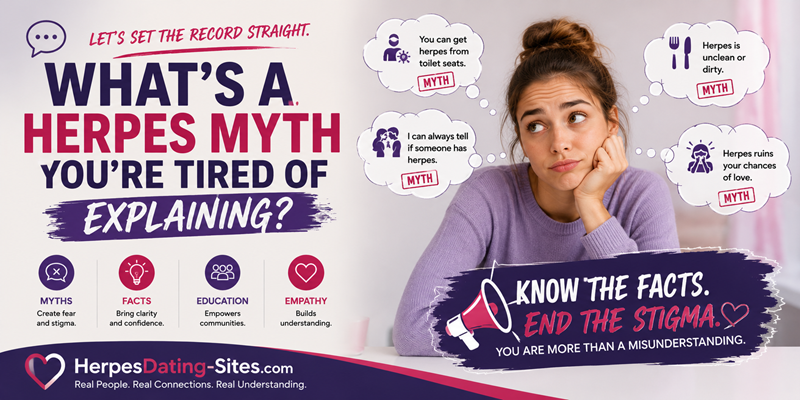
One of the biggest misunderstandings is that herpes only affects certain “types” of people. In reality, it can affect anyone who is sexually active. It doesn’t discriminate based on background, appearance, or relationship status.
Another myth is that herpes always shows severe symptoms. Many people have mild or no noticeable symptoms at all, which is also why transmission can happen without awareness.
There’s also the belief that herpes defines someone’s dating life or makes relationships impossible. That simply isn’t true, but the stigma can make it feel that way.
These ideas don’t come from science—they come from outdated assumptions and lack of education.
This is why conversations around Herpes Myths Debunked matter so much in modern sexual health awareness.
Facts vs fears: what science actually says
Medical research has consistently shown that herpes is manageable and extremely common worldwide. It does not shorten life expectancy, and for most people, outbreaks become less frequent over time.
The problem is not the virus itself—it’s the misunderstanding around it.
When people learn the facts, fear usually decreases. But getting accurate information is still a challenge, which is why Herpes Facts Vs Myths continues to be an important topic in public health education.
Education helps replace panic with understanding. And understanding reduces stigma more effectively than silence ever will.
The emotional side nobody talks about
Beyond the medical facts, there’s a human side that often gets ignored.
Many people describe the first reaction to diagnosis as confusion, fear, or shame—not because of the condition itself, but because of what they think it means about them socially.
That’s where stigma becomes heavier than symptoms.
When someone feels judged or isolated, it can affect confidence, relationships, and mental well-being far more than the virus ever could.
This is why conversations about Herpes Stigma Awareness are just as important as treatment information.
Breaking stereotypes in real life
One of the biggest shifts happening today is how people are openly challenging old stereotypes.
Online communities, dating platforms, and support groups are changing the narrative. People are sharing their experiences honestly, which helps others realize they’re not alone.
The idea that herpes ruins relationships is slowly being replaced with a more realistic truth: communication matters more than anything else.
This is a core part of Breaking Herpes Stereotypes—showing that people can live normal, healthy, emotionally fulfilling lives.
Living with herpes myths vs reality
A lot of fear comes from misinformation like “you can’t date normally” or “you can’t have a healthy sex life.” But real-life experiences prove otherwise.
People in long-term relationships, marriages, and dating communities often report that honesty and understanding matter far more than diagnosis.
When both partners are informed, decisions become mutual, not fear-based.
That’s why Living With Herpes Myths needs to be replaced with lived reality—people are not defined by a diagnosis.
The role of education and awareness
Education is still the strongest tool against stigma. The more people understand transmission, symptoms, and management, the less space there is for misinformation.
Digital platforms are now playing a big role in spreading awareness, especially through personal storytelling and factual breakdowns.
This is where Herpes Education And Awareness becomes essential. When information is accessible, stigma loses power.
Even public health institutions like the Centers for Disease Control and Prevention highlight that awareness reduces spread and emotional harm more effectively than fear-based messaging.
Herpes misinformation online
Social media has helped awareness grow, but it has also amplified myths. A single misleading post can reach thousands of people faster than accurate medical guidance.
This is why STD Misinformation Herpes remains a serious issue. It spreads quickly, often without context, and creates unnecessary fear.
Balanced content, lived experiences, and medically accurate sources are needed more than ever to counteract this.
Community voices: what people are actually saying
In online support groups and private forums, a different story emerges compared to public stigma.
People often share that the hardest part wasn’t the condition itself—it was the fear of judgment before they understood the facts.
Many describe relief after learning how common it actually is and how many others are quietly going through the same experience.
Community reflections often include sentiments like:
- “I thought my life was over, but nothing actually changed except my mindset.”
- “The stigma was worse than anything physical I experienced.”
- “Once I talked openly with my partner, everything became easier.”
These voices highlight the importance of real conversations over assumptions.
FAQ: Common questions people still ask
Is herpes rare?
No. It is one of the most common viral conditions globally.
Can herpes be cured?
There is no cure yet, but it is manageable with proper care and awareness.
Can people with herpes have relationships?
Yes. Many people are in long-term, healthy relationships.
Is herpes always noticeable?
Not always. Some people have very mild or no symptoms.
Does herpes define someone’s life?
No. It is a medical condition, not a personality trait or limitation.
Final thoughts
The biggest issue around herpes today isn’t medical—it’s still social misunderstanding. The gap between facts and public belief keeps unnecessary fear alive, even though science has been clear for years. Real change starts when people choose honest conversation over silence. When Herpes Stigma conversations, Herpes truth explained, and STD misinformation herpes are replaced with facts, the entire experience around diagnosis becomes less isolating and more manageable.
What actually helps is simple: better awareness, less judgment, and more accurate education. That’s how Herpes stigma awareness grows and how Herpes myths debunked becomes more than just a phrase—it becomes reality in everyday thinking.